Category Archives: Start-up data

High growth and profits

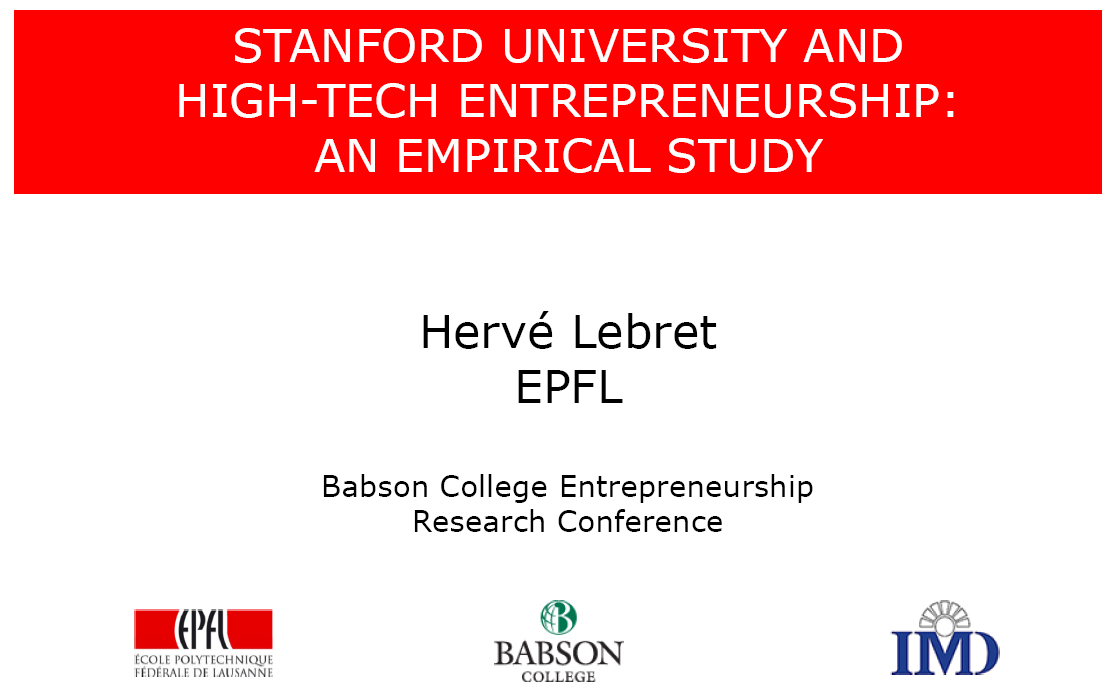
Before I talk about the topic I announce in this post, let me mention briefly my coming back in the research world! I published a paper at the BCERC Babson Conference on Stanford high-tech start-ups. You may wish to go through the slides below.
I promise to come back to growth and profits and indeed there is a link to my own paper so be a little patient. But I need to mention one other thing before! The two keynote speakers were great.

First Ernesto Bertarelli, former CEO of Sereno and winner (and loser) of the America’s Cup with Alinghi gave a great 20-minute talk on entrepreneurship. Let me just quote him:
– in entrepreneurship, you need passion, fire and love, these are critical,
– you need a team, you can not win alone so you need to accept to hire better people than yourself and you need to accept change,
– you need vision, i.e. you need to visualize your plan and objectives,
– entrepreneurship = business, i.e. it is about taking chances, about asking yourself why should I not do it,
– if you’re sure to win, it’s boring; the risk of failing is OK and he was honest enough to show his two victories and then his defeat with Alinghi.
In summary, it is not so much a process it is about values.
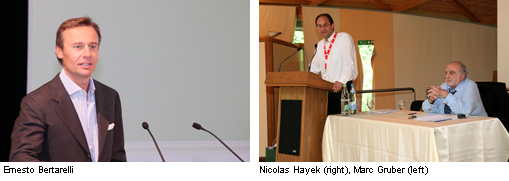
Second Nicolas Hayek, founder and chairman of the Swatch Group, gave his views about entrepreneurship and business. He said basically the same things. Entrepreneurs are creative people and the pity (with our current crisis) is that we train managers who are not risk-takers, who are not creative people (or only for creative finance!). In fact, we kill creativity with our kids when they are 6-years old and business schools / MBA programs do not change this.

So now that I have mentioned typical keywords of entrepreneurship, (this above is not new at all, but the speakers were great and convincing), I can elaborate on the title of my post . At the Babson conference, there was a paper entitled “MUCH ADO ABOUT NEARLY NOTHING? AN EXPLORATORY STUDY ON THE MYTH OF HIGH GROWTH TECHNOLOGY START-UP ENTREPRENEURSHIP”

As you may imagine, I was shocked. I was discovering a totally new field of research exemplified by Per Davidsson. High growth would not be as important as profits. Said this way, I do not think anyone would disagree. If you are interested, you should read “Davidsson, P., Steffens, P. & Fitzsimmons, J. 2008. Growing profitable or growing from profits: Putting the horse in front of the cart? Journal of Business Venturing” (pdf manuscript here) if you have the restricted access.

The reason why I was shocked is that my experience with high-tech start-ups is that profits come later than sooner as you need to develop a product that no customer would pay for its development. So first you lose money, usually through funding by investors. Then you grow and generate profits.

Indeed Davidsson is not saying the contrary: in his paper, he states that “For external investors, our results imply that high growth in a low-profitability situation is a warning signal rather than an unambiguous sign of positive development. However, we must caution that our results do not necessarily apply to the much more select group of high-potential firms that VCs invest in. First-mover-advantage (FMA) reasoning suggests radical innovators who create entirely new markets play under different rules to the average SMEs. This said, the lack of proof that size leads to eventual profitability is something that has concerned the very researchers who coined the FMA concept: (Lieberman and Montgomery, 1998:1122). Similarly, in the specific context of disruptive innovation, Christensen and Raynor (2003) have argued forcefully for patience for growth but impatience for profit, a notion directly in line with our ‘profits first’ arguments and findings for SMEs more generally. In combination with our results, this provides sound reason for external investors to put more emphasis on establishing profitability through VRIO resources within their portfolio of firms, and having more patience for the growth that can eventually realize the full value of opportunities developed and pursued by these firms.”

So you could think I feel better. Not at all! The paper “Much ado about nearly nothing” by Malin Brännback, Niklas Kiviluoto and Ralf Östermark, from Åbo Akademi University, Finland and Alan Carsrud, Ryerson University, Canada seems to indicate similar results in high-tech to what Davidsson is stating for SMEs. More specifically, another paper, “Growth and Profitability in Small Privately Held Biotech Firms: Preliminary Findings” by Carsrud and his colleagues states that “A high profitability-low growth biotech firm is more probably to make the transition to high profitability-high growth than a firm that starts off with low profitability and high growth.” Well maybe there is no contradiction between my views and theirs. It might be that start-ups are about outliers and probabilities then are, yes, very low to succeed from low profitability. I am still convinced high value creation comes from there and still, I doubt you can focus on profits first, on growth second in high-tech start-ups. It is however an interesting topic which if true, entrepreneurs, investors, policy makers and researchers should know better about!

Any reaction?

Europe vs. USA: growth in IT and Biotech

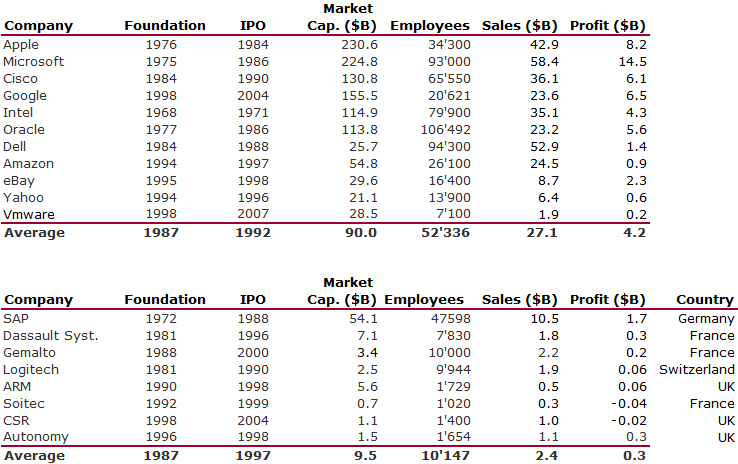
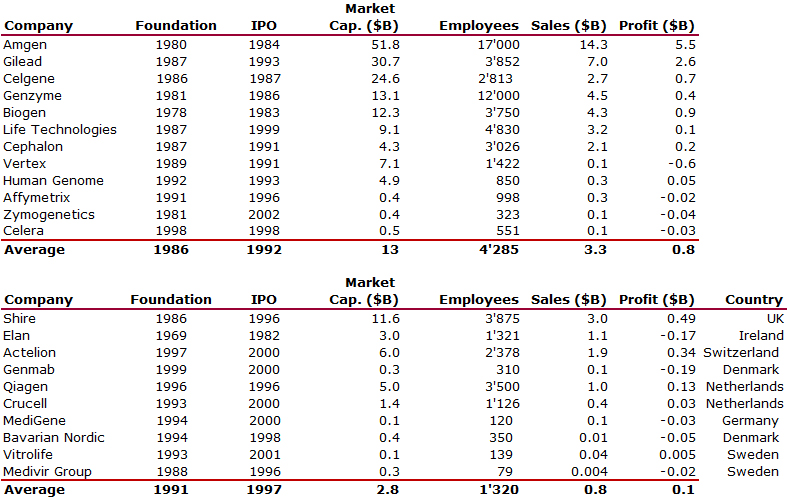
It is an exercise I usually like to use as an introduction to high-tech entrepreneurship: give me the name of 10 big sucess stories, and I mean (for example) the name of 10 public companies, which were founded as start-ups in the last 40 years. Usually, it is quite easy to give American names, and more difficult to find European ones. So the tables below give such names for IT first and for biotech second.

I had done the exercise in my book in 2007 but some companies such as Business Objects or Sun Microsystems have been acquired. Here I add the sales and profit numbers to the market caps and the number of employees.

What is striking I think, in addition to the difference in order of magnitudes is the difference between foundation to IPO year. Biotech is slightly different, though I am not sure it is fundamentally different… It is however interesting to notice that time to IPO is much more similar between the two continents in biotech than it is in IT.

The Google Story

This was the first chapter of my book! I have no real insider information about Google except my brief adventure with the Start-Up logo (that I use in this blog) when their people told me yes, no and finally yes about my right to use it. The book went out inbetween so it has a different cover but I obtained the right! I also failed in selling them a patent as they claimed they buy start-ups but not patents.

Still, I read so much about Google, it was sufficient material for my chapter but also for many presentations I made to students, entrepreneurs and in fact anyone interested in high-tech entrepreneurship and Google in particular… so after a few years of such presentations, I thought it was a good time to put online the Google Story which I hope you will find of some interest!

University licensing to start-ups

There’s been a long standing and passionate debate about what universities “deserve” when they license technologies to start-ups. There is the famous Google vs. Yahoo comparison where Google is an official Stanford spin-off which brought $336M in revenue from the equity the university owned in the start-up whereas Yahoo was considered as a hobby of the founders and no intellectual property was owned by the university. However one Yahoo founder gave some $75M to Stanford.

So what is a typical license between a university and start-up? Well there is no clear answer but the attached pdf file may be of help. I have done some search and found some info, mostly from US universities. I have also tried to find the rationals for or against such deals. The debate remains open and I do not expect a general agreement any time soon. But I hope this is contributing to the topic.

Survival or failure – which success?

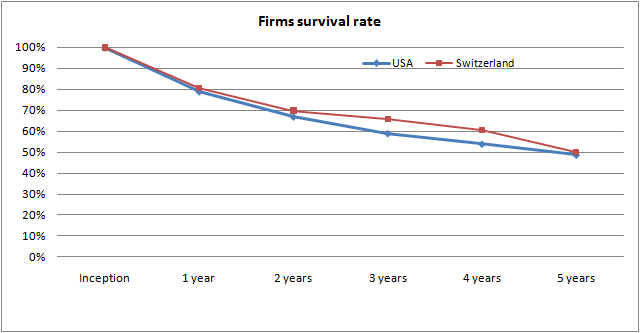
Failure and success are keywords in the world of start-ups. They even generate some heated debate, at least in Europe, when it is a question of surviving as long as possible until customers materialize or failing fast so that one avoids wasting precious time. The debate is difficult because all entrepreneurs deserve respect (yes, it is a tough job) and because slow and controlled growths (including survival modes) vs. fast and risky growths (with the risk of failing fast) may apply to totally different ventures. Here are therefore some figures that may contribute to the debate.

I must add that my motivation comes from a report published by ETHZ (the Swiss Federal Institute of technology in Zurich) about its start-ups, The performance of Spin-off companies at the Swiss Federal Institute of Technology Zurich. A 90% survival rate after 5 years was shown. But what are the typical survivate rates of firms? I searched the web sites of the US and Swiss institutes of statistics and the following chart illustrates the rates of the two countries for their entreprises overall.

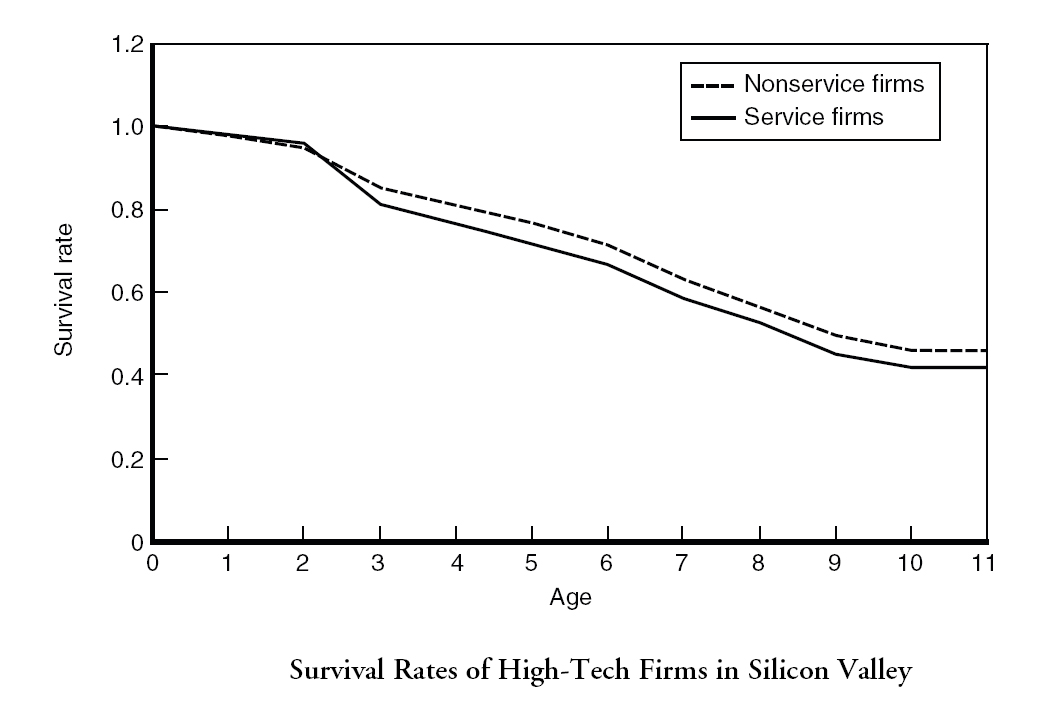
In high-tech, the survival rates seem to be even higher. The authors of the report I mention above give figures as high as 70% to 90% for 5 years. Zunfu Zhang in his excellent “High-Tech Start-Ups and Industry Dynamics in Silicon Valley” (dated 2003 ) published the following curves:

The survival rates after 5 years are 76% for “non-service firms” and 72% for “service firms”. The authors of the ETHZ report added: “The low survival rate in the US – where some of the most successful University spin-offs have been created – raises, however, the question whether a high survival rate is actually desirable or whether too strong a focus on creating ‘surviving’ spin-offs does not eliminate some of the potentially very successful ventures that may not look so promising or too risky.

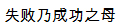
As a conclusion to this post, I’d like to extract the following from my book!

As a footnote, I had added, the saying is pronounced “Shi Bai Nai Cheng Gong Zhi Mu” and means “failure is the mother of success”. There is a very similar quote by T. J. Rogers, founder of Cypress and another Silicon Valley icon: “failure is a prerequisite to success”. A Chinese student, Jie Wu, noticed the similarity. I would like to thank him for this. It might be encouraging to end this [post] with a quote, which shows that Silicon Valley mentality can be developed elsewhere. What we need to digest is that failure is not negative, but trying is what counts.

Gazelles and Gorillas – part 2

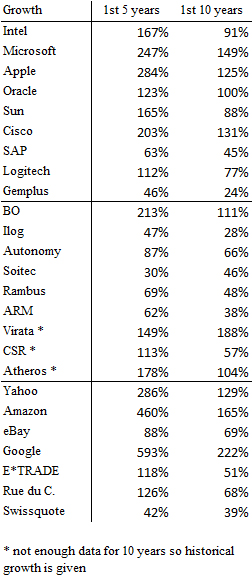
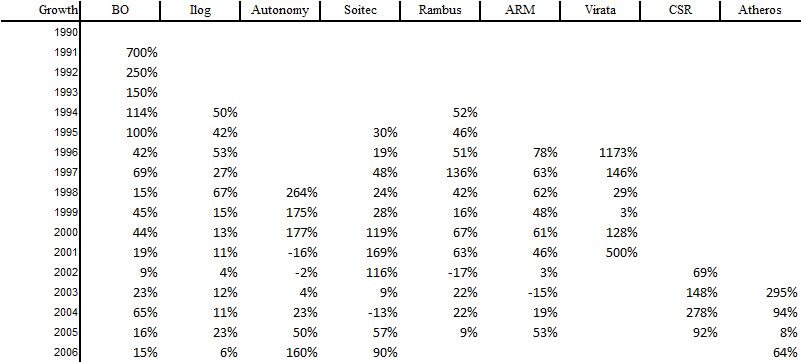
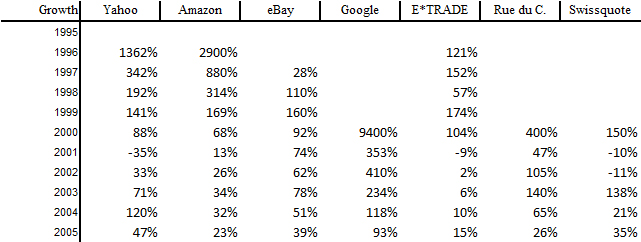
Following my post of April 19, Gazelles and Gorillas – high growth startups, I went back to the chapter 8 of my book where I compared the growth of the European and American gorillas. I had not computed then the 5-year and 10 year growth of these very successful companies. The following table gives the results of my work this morning. These are not gazelles (20% growth), there extremely fast gazelles!

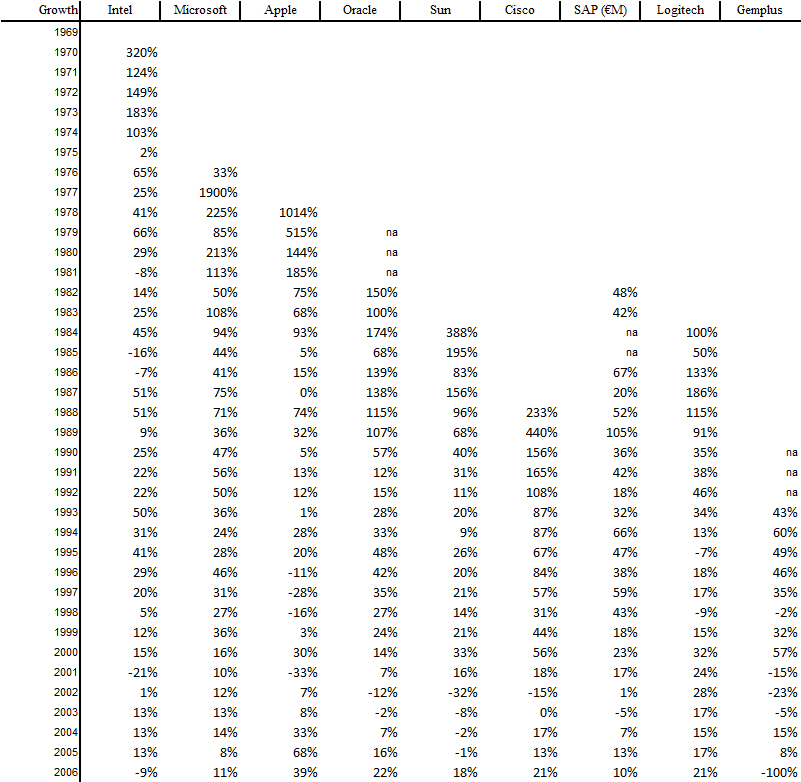
Gorillas seem to grow at 100% rates or doubled their sales each year on average… Now growth is never an easy path (ask Steve Jobs about Apple growth!) so let me add much more details. Below, you will see the yearly growth of all these companies and you may notice there are sometimes a lot of ups and downs!

Gazelles and Gorillas – high growth startups

Since I have been interested in start-ups, i.e. 1997, I have always been puzzled about the macroeconomic impact of start-ups, i.e. fast growing companies, mostly in high-tech. The famous Intel, Apple, Microsoft, Cisco, Yahoo, and other Google have an impact, but what is it exactly for the economy?

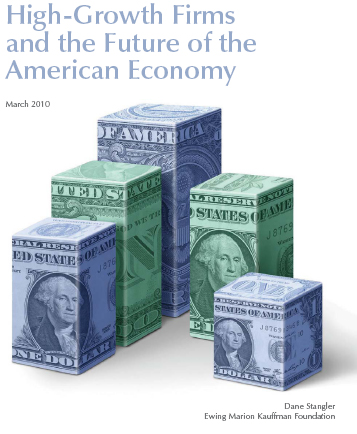
Surprisingly, it is not that well-known. I have read in the past weeks some recent papers on the topic that you may download if you are interested. The Kauffman foundation which I have mentioned already is doing a great job and particularly Dane Strangler. He is the author of High-Growth Firms and the Future of the American Economy and of Exploring Firm Formation: Why is the Number of New Firms Constant? as well as Where Will The Jobs Come From?

Thanks to his reports, I became aware of older studies such as Gazelles as Job Creators – A Survey and Interpretation of the Evidence and High-Impact Firms: Gazelles Revisited both dated 2008. Finally the Brittish government has its own study, High growth firms in the UK: Lessons from an analysis of comparative UK performance.  This last report is interesting as it not only considers gazelles, the fast growing companies, but also gorillas, the young fast growing companies which reached a large size in less than 10 or 15 years.

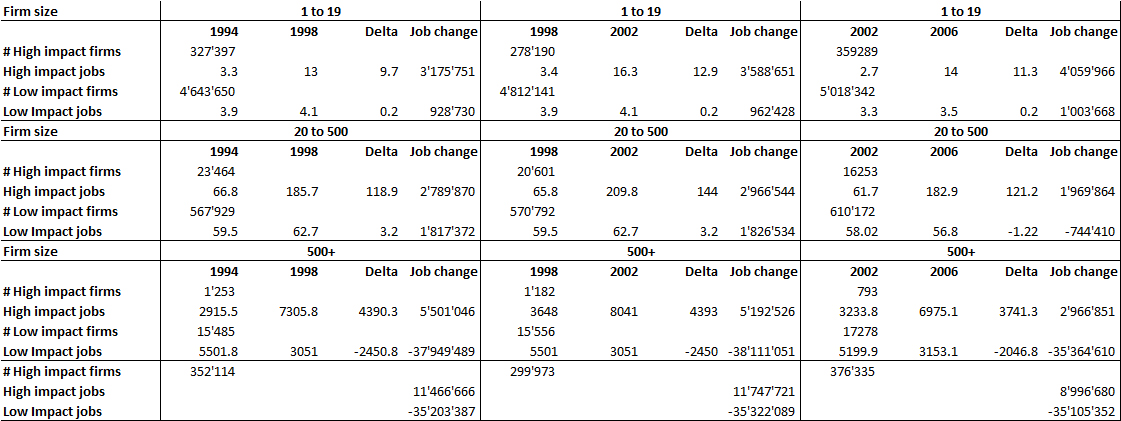
The first answers were provided in 1981 by David Birch who showed that large firms were not the providers of job creation anymore. But even today, the answer to the question is not so clear. At least it took me longer than I would have thought to understand what all these reports claimed. So for example, here is a table of how small, mid-size and large firms create jobs in the USA. The numbers come with no real guaranty as I have compiled them from a number of sources, mostly the High-Impact Firms: Gazelles Revisited

So what does this mean? First high-impact firms contribute to most of the new job creation in the USA. What are high-impact firms? These are the firms which grow at a 20% annual rate (in jobs and sales*), the fast growing firms. As you may see, low-impact firms also create jobs but only if they are SMEs (small and mid-size). It explains why we think that fast-growing small firms are so important.

But it is an over-simplification. High-impact firms are not small and all these studies also show that:

– they are not young. On average, they are 25-years old.

– they are not necessarily high-tech, they can be found in all sectors of the economy.

– a minority is VC-backed. This is obvious as we have here about 300’000 gazelles and probably only a few thousand companies are VC-backed each year in the US.

More on gazelles here. Now, what about Gorillas? Gorillas are extremely fast growing and young companies. The UK report above defines them as less than 15 years old, with the same growth as gazelles. I remember that Geoffrey Moore defines them as leaders in their market. Well, not much is known about them. The UK report mentions there was no Gorilla in the UK whereas Yahoo, eBay, Amazon, Yahoo and Google were Gorillas in the USA.

Dane Strangler in his report is providing more interesting data. They are not the gorillas per se, but probably quite close:

– In any given year, the top-performing 1 percent of young firms generate roughly 40 percent of new job creation.
– Fast-growing young firms, comprising less than 1 percent of all companies, generate roughly 10 percent of new jobs in any given year.

Qiote impressive! Well, I still do not have all the answers I would like to have, but I now know gazelles are important, and gorillas maybe even more. And at the end, what is the impact of high-tech, of venture capital is just another but interesting story!

*: Growth in terms of jobs is more complex than 20%… experts use the Employment Growth Quantifier (EGQ), that is the product of the absolute and percent change in employment over a four-year period of time and take it as bigger than 2 for “high-impact”… A 20% increase in sales is also a factor 2 over the same period of time.

Apple Computer to acquire FontSelf?

Apple Computer should announce soon the acquisition of Lausanne-based FontSelf. In an usual move, the Cupertino-based company will acquire a stealth-mode start-up specialized in the design of fonts. It should be no surprise for those who know that the famous Helvetica font was created in Switzerland.

“Apple Computer is famous for its design and creativity so when we heard about FontSelf, we had a careful look, tested it and we were delighted. This is a great addition to our software and web applications” declared April Feel, head of Apple Computer Public Relations.

In 2005, at the commencement ceremony of Stanford University, Steve Jobs had declared “Stay Hungry, Stay Foolish”. FontSelf shows that staying young and curious is a critical need of human life.

sjobs.gif

“Stay Hungry, Stay Foolish” Steve Jobs said. Yes it was an April Fool, but FontSelf is a great and beautiful tool.

Maxlinear IPO and shareholders

Maxlinear is new technology company going public and good news, it is a semiconductor company. You will find all the info you need on the web. Xconomy most recently annouced the Maxlinear IPO: MaxLinear IPO Prices Stock Above Range at $14 a Share

So here is my usual and favorite work on such companies: its equity structure, its investment story together with the pie chart. I have done it fast so I do not promise it is out of mistakes but it gives once again a good view on how founders, investors and employees are diluted.

Tesla Motors and Paypal, a tale of two founders

Tesla Motors recently filed to go public. Behind the success story is a strange tale of founders. You should read first the Wikipedia page about Tesla. You will see that there are five founders. Because there’s been a litigation and a judge decision, it shows that defining a founder is not so easy. My definition of founders would be limited to Martin Eberhard and Marc Tarpenning, but because their initial business angel has become the CEO, it is more complex according to the judge.

What is even more interesting is that Elon Musk, the BA and CEO, was a founder of Paypal, or more precisely of one of the two start-ups which merged to give Paypal (X.com and Confinity). Then he was fired or left Paypal, similarly to what Musk did to Eberhard and Tarppening. Amazing, no?

So I provide here two cap tables! The Tesla one first and the Paypal one follows. I hope you will appreciate the information and you can react about founders, investors and the sometimes sad stories behind the scene of success stories…

First the Tesla equity tables and investors. Click on the pictures to read them!

The reason why there are green cells is because the company is not public yet. So the IPO date and price per share are fictitious. I do not know how much the founders exactly have but there was apparently about 8M founders’ shares. Now the company has raised a lot of money:

Finally, here is how the share dilution occured:

Am I doing here a Freudian analysis? Whatever is the Paypal stories through the X.com and confinity merger:

The equity table

and the investors

The beauty of all this is that behind the numbers, their complexity, there are many untold stories about founders, business angels, investors and success. React…