Author Archives: Hervé Lebret

New IPO filings (AVG Technologies) and new start-ups stats

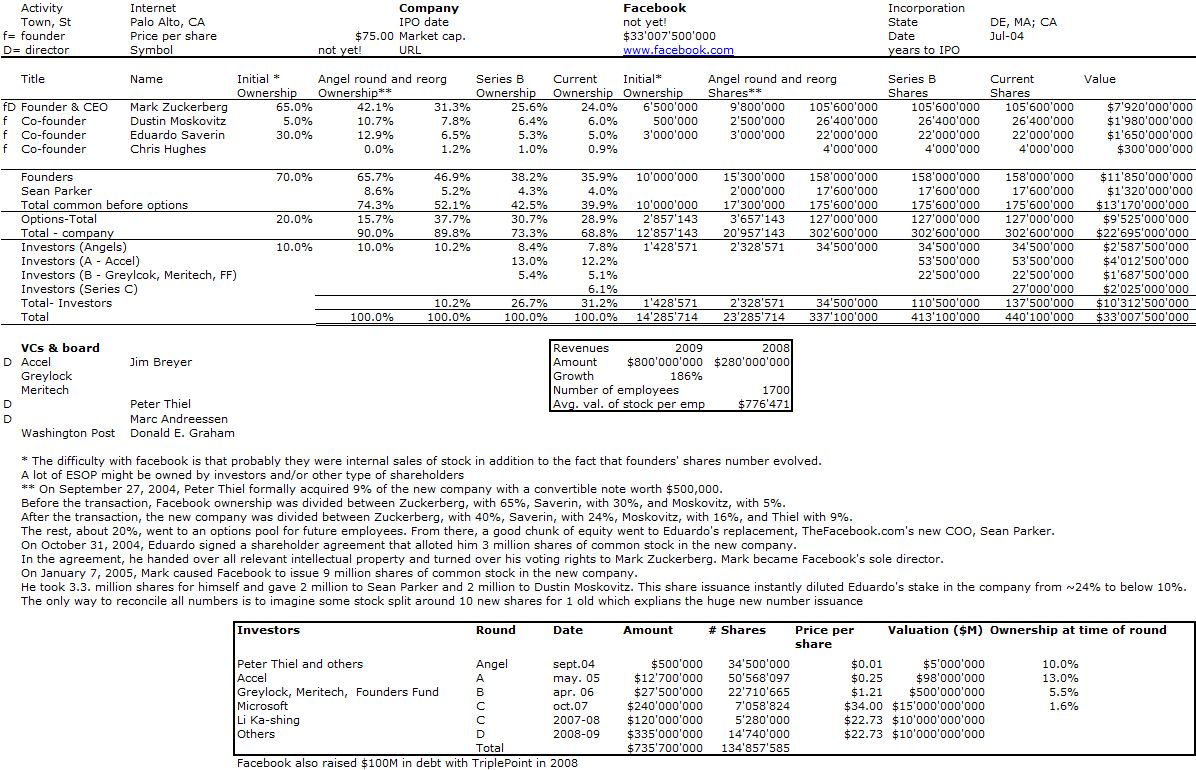
I noticed at least 4 IPO filings this month, not bad. These are Audience, Infoblox, Millennial Media and most important to me as a European citizen, AVG Technologies. European filings in the USA are sufficiently rare to be noticed, and this time the company has Czech origins. After discussing AVG, I will show you an update of my start-ups data coming from these filings.

AVG did not experience the typical start-up process. Indeed the founders sold their shares to a private equity group in 2001, ten years after the incorporation. The investors then grew the company and attracted new investors including Intel Capital, TA Associates as well as a Polish fund. You may know about AVG, I am using it as a free anti-virus but I did not know it was a European start-up…


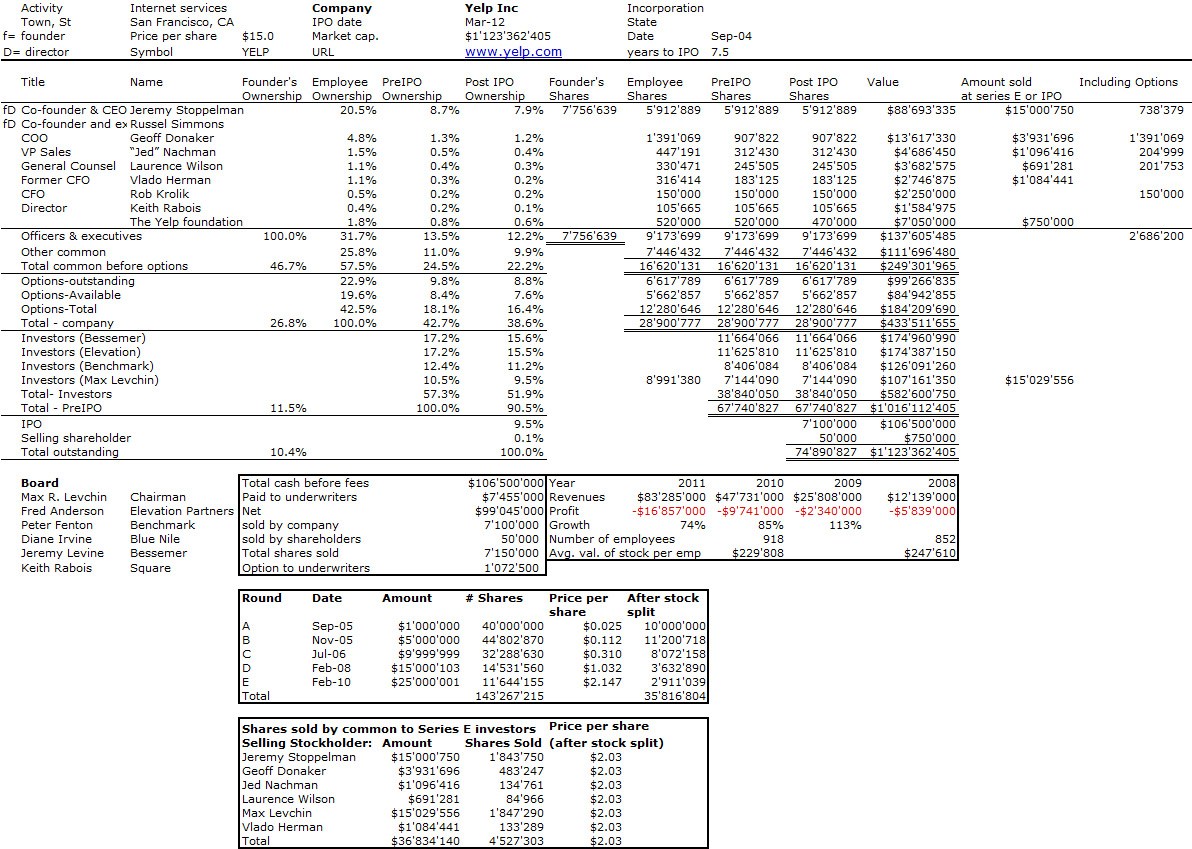
Click on picture to enlarge

The revenue growth is quite impressive as you can see in the cap. table (about $150M in 2010 from $100M in 2008). I found a 2000 presentation where the founder gave the facts and figures for 1996-2000. Then the revenues were respectively 17M and 55M Czech Korunas. One Krona was about €0.03, which means in the €0.5-1.5M. Not a bad growth at all. Why did the founders sell, I do not know and I am not even sure what they do today. They do not seem to be role models in Brno. Tomas Hofer seems to be active in another start-up however. If someone has more information on the founders, please comment or contact me.


Tomas Hofer

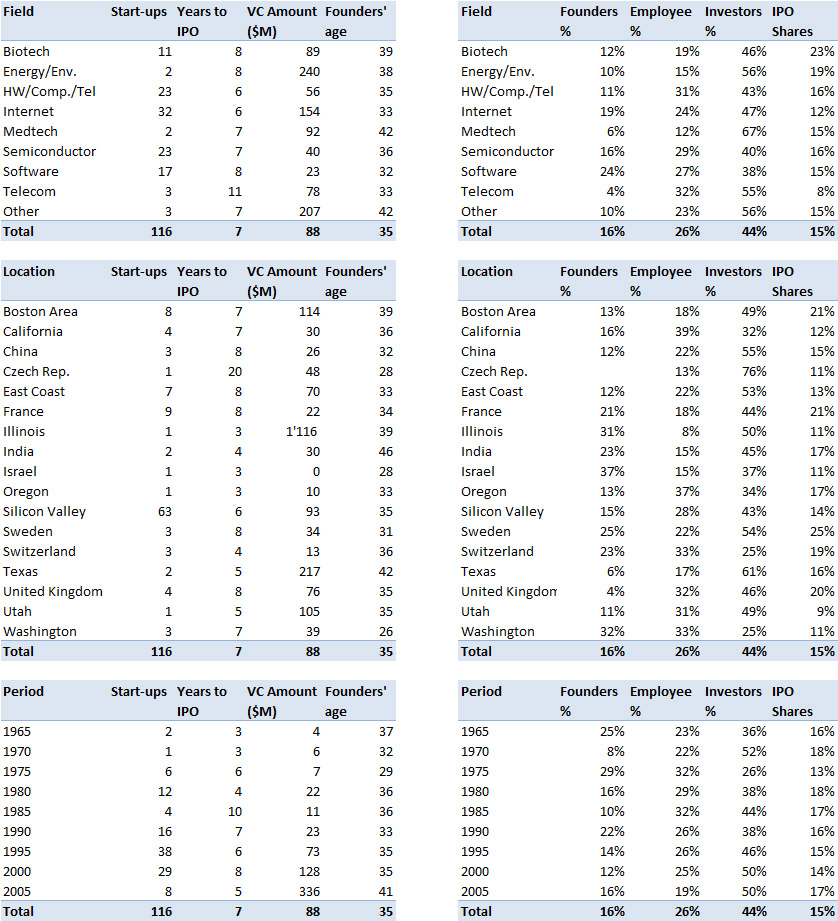
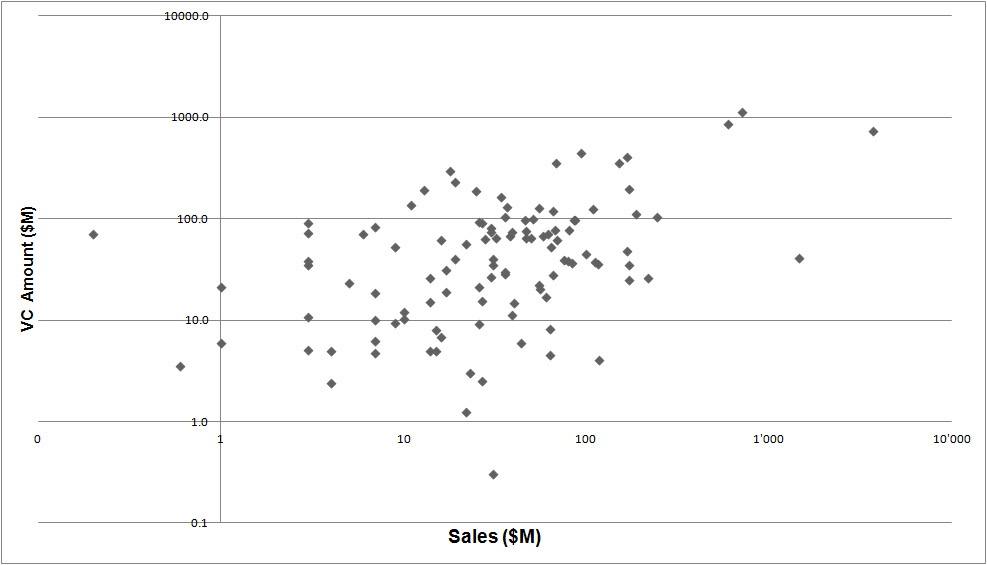
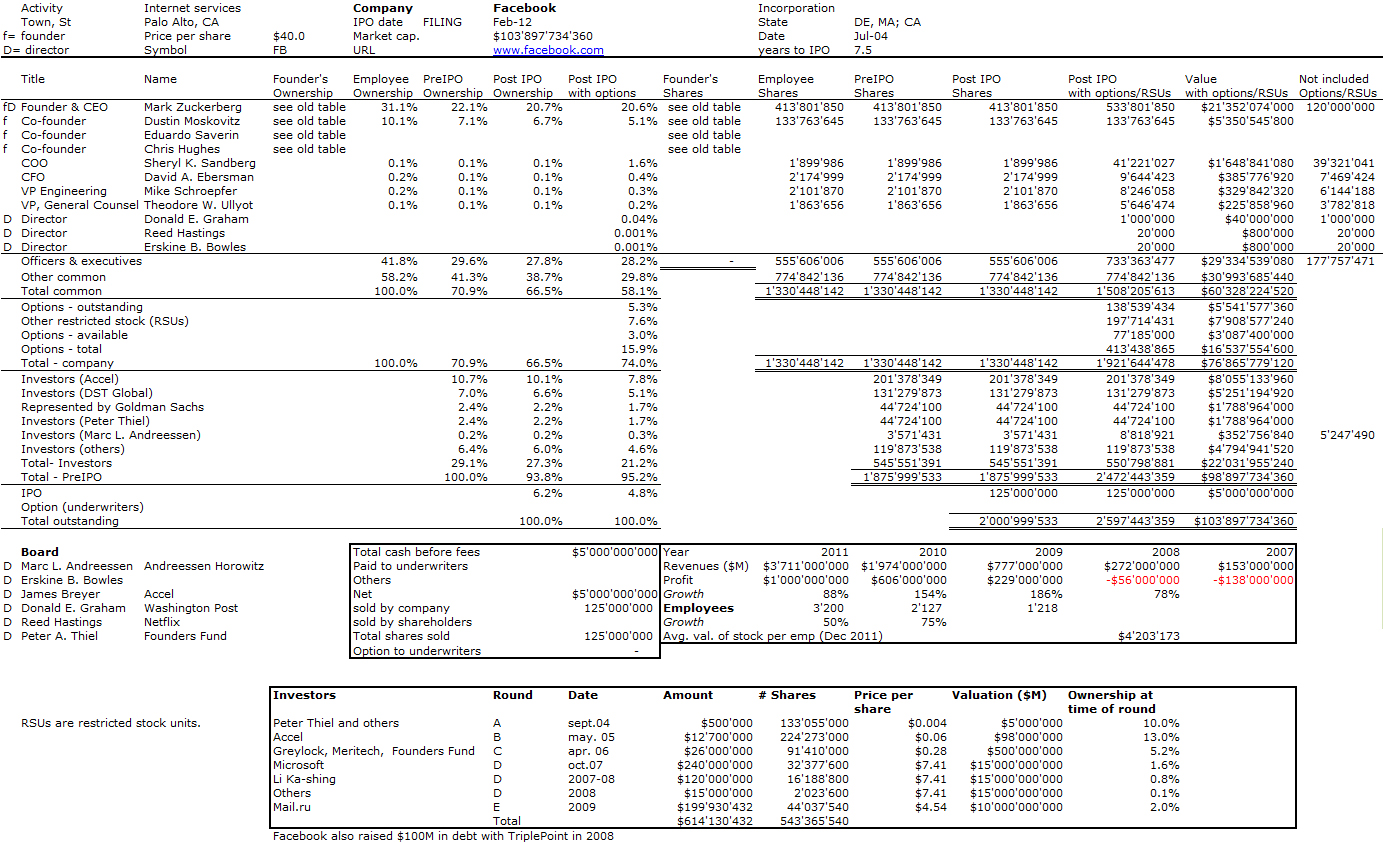
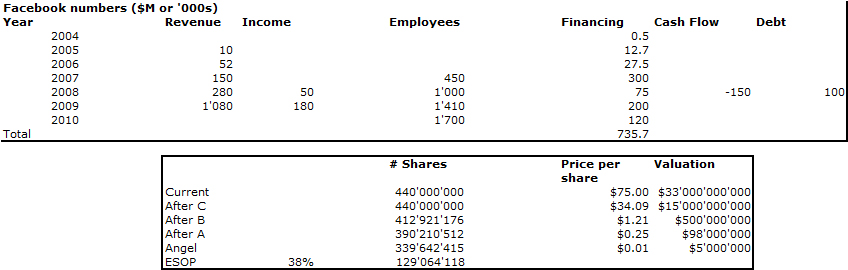
You can visualize the other cap. tables in my full data document. I do not have much to say about them, but I have updated my stats in the tables which follow, including new data on the amount of VC money raised. I also did a new classification in addition to geography and fields: years of incorporation.


Click on picture to access full pdf data

Innovation is not about small or large, it’s about fast.

The debate is recurrent and in my last post, I was questioned about my fascination for start-ups and Silicon Valley. In a way this is related, I will come back on this at the end. Two recent articles nearly surprised me. The first one has a famous author, Clayton Christensen. The Empires Strike Back – How Xerox and other large corporations are harnessing the force of disruptive innovation was published in the latest issue of the MIT Tech Review.

Here are short extracts: “It has been a long time since anyone considered Xerox an innovation powerhouse. On the contrary, Xerox typically serves as a cautionary tale of opportunity lost: many obituaries of Steve Jobs described how his fateful visit to the Xerox Palo Alto Research Center in 1979 inspired many of the breakthroughs that Apple built into its Macintosh computer. Back then, Xerox dominated the photocopier market and was understandably focused on improving and sustaining its high-margin products. The company’s headquarters became the place where inventions in its Silicon Valley lab went to die. Inevitably, simpler and cheaper copiers from Canon and other rivals cut down Xerox in its core market. It is a classic story of the “innovator’s dilemma.” […] But now Xerox is turning things around […] In the past, Xerox’s success would have been an anomaly. Less than a decade ago, when we were finishing the book The Innovator’s Solution we highlighted the fact that disruptive innovations are typically introduced by startups, the rebel forces in the business universe. […] Throughout the 1980s and 1990s, only about 25 percent of disruptive innovations we tracked in our database came from such incumbents, with the rest coming from startups. But during the 2000s, 35 percent of disruptions were launched by incumbents. In other words, the battle seems to be swinging in favor of the Empire, as the following examples confirm. The author mentions examples such as GE, Tesla competing with GM, Dow and Microsoft in the article.

The second article comes from The Ecomist and is entitled “Why large firms are often more inventive than small ones.” Let me quote it a little more extensively: “Joseph Schumpeter […] argued both sides of the case. In 1909 he said that small companies were more inventive. In 1942 he reversed himself. Big firms have more incentive to invest in new products, he decided, because they can sell them to more people and reap greater rewards more quickly. In a competitive market, inventions are quickly imitated, so a small inventor’s investment often fails to pay off. […] These days the second Schumpeter is out of fashion: people assume that little start-ups are creative and big firms are slow and bureaucratic. But that is a gross oversimplification, says Michael Mandel of the Progressive Policy Institute, a think-tank. In a new report on “scale and innovation”, he concludes that today’s economy favours big companies over small ones. Big is back, as this newspaper has argued. And big is clever, for three reasons.” The arguments are that 1-ecosystems are big, 2-markets are globals and 3-problems to be solved on a large scale. This is not for small companies. “He is right that the old “small is innovative” argument is looking dated. Several of the champions of the new economy are firms that were once hailed as plucky little start-ups but have long since grown huge, such as Apple, Google and Facebook. […] Big companies have a big advantage in recruiting today’s most valuable resource: talent. (Graduates have debts, and many prefer the certainty of a salary to the lottery of stock in a start-up.) Large firms are getting better at avoiding bureaucratic stagnation: they are flattening their hierarchies and opening themselves up to ideas from elsewhere. Procter & Gamble, a consumer-goods giant, gets most of its ideas from outside its walls. Sir George Buckley, the boss of 3M, a big firm with a 109-year history of innovation, argues that companies like his can combine the virtues of creativity and scale.”

Well I was not surprised for long. The debate is not about small or large. Let me explain by quoting my book again and more specifically the section Small is not Beautiful [page 111] “There is one misunderstanding concerning start-ups. Because they would be young, recent companies, and because many macroeconomic analyses focus on the jobs generated by small structures, there is a tendency to consider with high regard that “small is beautiful” as if it were a motto for start-ups. The ambition of a start-up is not to stay modest. On the contrary, the successful companies have become large, sometimes dinosaurs. In early 2007, Intel had 94’000 employees, Oracle 56’000, Cisco 49’000 and Sun 38’000. These “start-ups” have become multinational companies. […] The San Jose Mercury News, the daily newspaper at the heart of Silicon Valley, publishes once a year for example the list of the 150 biggest companies. The simple comparison of the list between 1997 and 2004 shows that among the top 50 in 2004, 12 were not part of the first 150 in 1997. Zhang also analyzed this astonishing dynamics by comparing the 40 biggest high-tech Silicon Valley companies in 1982 and in 2002 as provided by Dun & Bradstreet. Twenty of the 1982 companies did not exist anymore in 2002 and twenty one of the 2002 companies had not been created in 1982. These dynamics of birth and death are known and positively acknowledged.”

It is exactly what the Economist article explains: “However, there are two objections to Mr Mandel’s argument. The first is that, although big companies often excel at incremental innovation (ie, adding more bells and whistles to existing products), they are less comfortable with disruptive innovation—the kind that changes the rules of the game. The big companies that the original Schumpeter celebrated often buried new ideas that threatened established business lines, as AT&T did with automatic dialling. Mr Mandel says it will take big companies to solve America’s most pressing problems in health care and education. But sometimes the best ideas start small, spread widely and then transform entire systems. Facebook began as a way for students at a single university to keep in touch. Now it has 800m users. The second is that what matters is not so much whether companies are big or small, but whether they grow. Progress tends to come from high-growth companies. The best ones can take a good idea and use it to transform themselves from embryos into giants in a few years, as Amazon and Google have. Such high-growth firms create a lot of jobs: in America just 1% of companies generate roughly 40% of new jobs. Let small firms grow big The key to promoting innovation (and productivity in general) lies in allowing vigorous new companies to grow big, and inefficient old ones to die. On that, Schumpeter never changed his mind.”

I say it again, there is a difference between start-up and SME. This does not fully answer Christensen argument about the Empire striking back. Well it means large companies have smart managers who learnt from the mistakes of the past. But he also implicitely say that 65% of disruptive innovations come from new comers, not incumbents. Gazelles still have a bright future.

Patents inhibit innovation, let’s delete them!

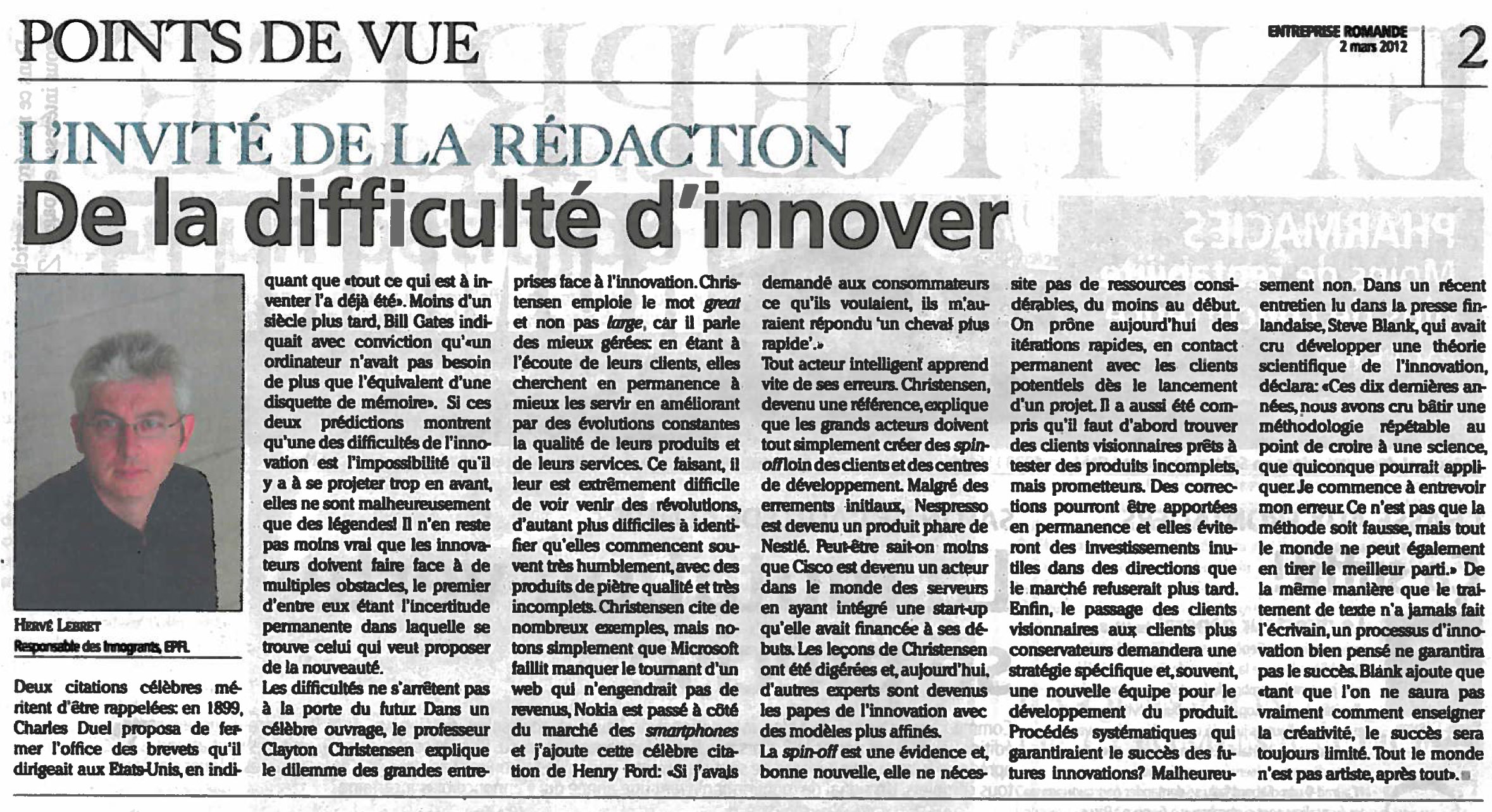
My first post for 2012 is a translation of an interview I gave to French magazine La Recherche. It was published last December and you can have an electronic version of the French version here or a pdf document by clicking on the cover page below. It is followed by my own translation. Now I should say that I was a little surprised by the title which I had not expected. I was more thinking in something like “start-ups are the forgotten children of innovation!” The title focused on my cautiousness about IP and patents in particular. It is certainly too strong, but that is what titles are made for…

Patents inhibit innovation, let’s delete them!

Innovation is a matter of culture. An admirer of Silicon Valley, which he has known for twenty years, Hervé Lebret calls for Europe to be inspired by the dynamism and creativity of its start-ups. But is it good to take everything in this model?

La Recherche: A report of the Commission of the European Union stresses that the EU is more increasingly lagging behind the U.S. in terms innovation with a comparable level of research [1]. How do you explain that?
Hervé Lebret: The main reason for this innovation gap in Europe is cultural. I was always struck by how much the students are interested in the applications of research in the U. S., while in Europe we think more in terms of knowledge. And then there are the role models of young entrepreneurs who have experienced success. It is striking in Silicon Valley: Bill Gates was 20 when he founded Microsoft, Steve Jobs 21 when he founded Apple, Larry Page and Sergey Brin, 25 when they created Google. They are powerful models to which a young student can identify to.
La Recherche: The same report argues that another reason for the gap is partly related to differences the patent system which would be more complex and more expensive in Europe. What do you think?
HL: I am skeptical about legislation or rules in general as an explanation in the differences. It is in the people’s head that things happen. In the U.S., they want to try; they have no fear of failure. I am not convinced that we are more innovative because we would have more patents. Look at Switzerland, which has the largest number of patents per capita: this country does not create many start-ups. Incentives and policies are only working if there is a favorable cultural terrain.
La Recherche: But aren’t patents the key for an innovative company, whose value often relies on its intellectual property?
HL: Software is not patentable, and this did not prevent Microsoft to be successful. With the risk that you see me as iconoclastic, I think that patents are an obstacle to innovation. I wonder whether we should not remove them, except perhaps in specific areas, such as biotechnology, where a patent corresponds more specifically to a manufacturing process of a molecule.
But in most industrial fields, you need to own thousands of patents to protect the innovation which is commercialized. The maintenance of this portfolio of patents is extremely expensive and that money could be better used in research and development. Whereas in the past the patent favored the inventor, it has become a defensive weapon to protect dominant positions. Look at the war between Apple and Google: the first alleges that the second has developed its operating system Android by violating certain of its patents. This goes against the theory that the traditional patent protection the weak inventor, who can develop an idea during years without fear of being stolen.
Does the weakness of venture capital, which would deprive young innovative companies from the capital needed for their development, explain some of the shortcomings of innovation in Europe?
H.L. Contrary to general belief, there has always been venture capital in Europe, especially in France. This is not a quantitative but qualitative problem: venture capital in Europe is run by people from finance or consulting, not entrepreneurs.
Again, this is a cultural difference. But this is changing. Former entrepreneurs have recently begun to create venture capital funds or to become business angels. In France, I think of Bernard Liautaud, founder of software company Business Objects, or Xavier Niel, founder of Free, the phone operator, who both joined venture capital firms. The founders of Skype have created Atomico, their own funds.
You do not hide your admiration for Silicon Valley. If the secret of its strength is, as you support, cultural, how can we be inspired in Europe?
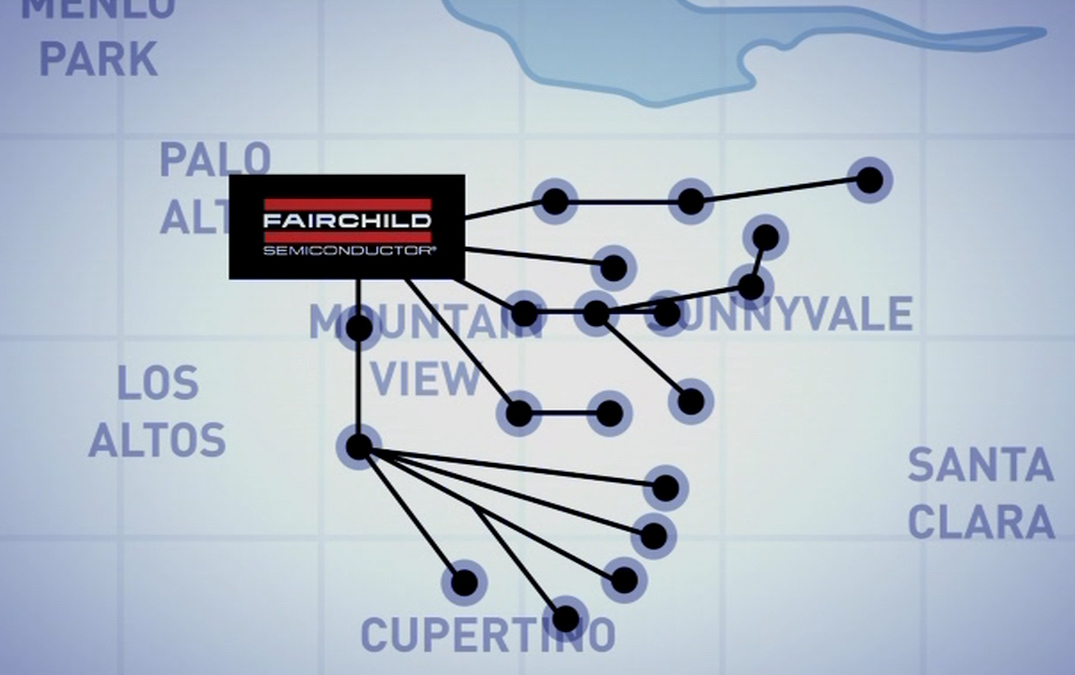
H.L. We can draw on customs, practices, an important one being cooperation. In Silicon Valley, curiosity is shared. People know that the exchange of ideas is successful, and are not afraid of ideas being robbed. The two Google founders were PhD students in two different laboratories at Stanford University, but they have talked! It is not unusual o talk to your competitor to solve your own problems: in the 1960s, the major industry semiconductor players in California met at the Wagon Wheel bar in Mountain View to discuss their work. In Europe, many laboratories, academic and probably more private, have a culture of secrecy, they fear the exchange.
What do you put in place at the Ecole Polytechnique Federale de Lausanne (EPFL), where you teach, to develop a taste for innovation and entrepreneurship among students?
H.L. I strongly believe in the role of exemplary models. So I organize conferences with successful entrepreneurs who share their experience. This shows students that these are passionate people, who are not afraid to try, even if just one in a thousand will be successful. These models inspire. But inspiration is nothing without resources. Hence the program “Innogrants”: a salary of one year for a young researcher who is released from its research and teaching in order to concentrate on her or his innovative projects. If it works, it is hoped that the private sector will further invest. Fifty Innogrants were awarded in five years. Half of them have led to the creation of companies in life sciences, micro-or nano or information technology. And five of them have found private investors.
It nevertheless remains modest …
H.L. Yes, we must remain humble: all we can do is create a breeding ground for the creation of innovative companies, as we do with Innogrants. In total, in the last fifteen years, EPFL innovators have created about a dozen start-ups per year. Fifteen have raised venture capital, 300 million Euros in total. Four or five have been sold to industry groups, sometimes these were nice exits. Endoart, founded in 1998 at EPFL specialized in the production of remotely controllable medical implants; it has been sold nine years later for 100 million dollars to Allergan! But we feel there is a kind of modesty, self-restraint of European entrepreneurs compared to their American counterparts.
A former researcher at EPFL criticized the leadership of the university of “copy as closely as possible the American university model” [2]. Do you think everything is good in the American model?
H.L. These criticisms focus on science, not on innovation. The competitive standing of researchers, the instability of the statutes is not a good idea in research. It is very important to let the imagination speak. There is a danger to keep people under permanent pressure. But in terms of innovation, the U.S. model works.
You estimate that at most one in a thousand start-ups meets success. Isn’t this a huge waste?
H.L. We should not measure everything in terms of money or performance. What counts is creativity. For me, the Silicon Valley is the new Athens. As Greece, it is a culture: what this region brought in fifty years is fabulous. Digital technologies that were invented forever changed the way we inform, we cultivate and entertain ourselves. This is probably why the death of Steve Jobs, who was an iconic character, had so many repercussions in October. Furthermore, if one thinks in macroeconomic terms, I do not think that the American model is based on waste only. In the U.S., venture capital weighs about twenty billion dollars a year. For twenty years, 400 billion have been invested. And one company, Google, is now worth $200B. Finally, the creation of economic value is similar to the money invested. It is a collective success, even if it is based on thousands of individual failures, which are often very hard humanely.

The entrepreneur should be at the center of innovation policy

Isn’t the $200 billion market capitalization of Google exaggerated when compared to the actual value of the company?
H.L. The world of venture capital has unfortunately become a financial asset like any other. It is no longer a world of former entrepreneurs who pursue their business while investing in those of others. There is too much money, too much speculation in the U.S. venture capital. But I remember that the start-ups appeared before the Nasdaq, the stock market where shares of high technology companies are traded. Silicon Valley began in the 1960s and 1970s in the context of the counter-culture in California. Steve Jobs did not hesitate to say that some of his creativity came from drugs when he was young. The growing role of finance in the economy only started in the 1980s. Originally, the financiers were the patrons of great artists. That said, I think the current trend of large groups limiting their spending in research and development is catastrophic. Shareholders want 15% return and push to cut spending on research. Good start-up can only emerge if there is also good private research.
Do we see a slowing of the technological innovation?
H.L. I am indeed concerned about the lack of success in current innovation: the 1970s were marked by the transistor, the 1980s by the personal computer; the 1990s by the networks. But in the 2000s, I see nothing new. The Web 2.0 is not a technological revolution, it is a consolidation. More generally, biotechnology was rather disappointing; there is no revolution in energy, chemistry. It is not clear that nanotechnologies are really promising technological breakthroughs. I fear that the 2000s did not create start-ups which are equivalent to Intel in the 1960s, Apple, Microsoft or Genentech in the 1970s, Cisco in the 1980s, or Google in the 1990s. There is Facebook, but this company does not rely on high technology innovation. That said, there has always been a general pessimism about the future of innovation, so I hope to be wrong!
You mention companies in information technology or biotechnology. Is this model of start-up transferable to capital-intensive areas, and where there are already major players, such as aerospace, automotive, chemicals?
H.L. The established players are not necessarily the most innovative. Clayton Christensen from Harvard Business School, showed in 1997 that an established company is great at improving existing products [3]. It is innovation by evolution, not revolution. Renault can invent the electric car, but not a new mode of transportation. Besides, the idea of the minivan, which was then copied, did not come from internal R&D at Renault, but from the company Matra, who did not have the same experience in automotive, which made it more creative. It is also for this reason that the big companies, especially pharmaceuticals, outsource their innovation: they prefer to leave the start-up take the risks, and then buy them. Even an old startup such as Cisco replaces the term “research and development” by “acquisition and development”.
Why do you insist so much on start-ups? An academic institution can also license its patents to the industry, or form mixed private / public laboratories…
H.L. The basic problem is towards whom an innovation policy is directed. My belief is that the entrepreneur must be central. This is not what is done in France: the clusters are clusters of established companies, not tools to promote creativity and entrepreneurship. I insist on start-ups because I think they are the forgotten piece of innovation policies. Of course there is innovation in large groups. But I wonder if they can do disruptive innovative. They can set a goal – the flat screen, the smart phone, or, today, the electric car – that will come out in twenty years. But can they do something entirely new, as did Google? Or Genentech, which revolutionized the manufacture of drugs using genetic engineering techniques? I believe that only start-ups are able to do so. Christensen said if you want to make a major innovation, create a branch and place it as far as possible of your research center as the worst enemy of innovation in a company is conservatism. Innovation is the highest in small teams: this is what happens in the start-up.

■■ Interview by Nicolas Chevassus-au-Louis

[1] European commission, Innovation Union Competitiveness Report 2011, http://ec.europa.eu/research/innovation-union.
[2] Libero Zuppiroli, La Bulle universitaire. Faut-il poursuivre le rêve américain ? Éditions d’en bas, 2010.
[3] Clayton Christensen, The Innovator’s Dilemma, Harper’s, 1997.

Hervé Lebret. A graduate of Ecole Polytechnique and Stanford University, with a Ph.D. in electronics, he worked, after a few years as a researcher, as a venture capitalist, in Geneva from 1997 to 2004. Since then he has been teaching management of technology and manages a seed fund at the Ecole Polytechnique Federale de Lausanne.

> Hervé Lebret, Start-up. What we may still learn from Silicon Valley Create Space, 2007. www.startup-book.com
> www.oecd.org/sti/scoreboard An oecd study on patents
> http://vpiv.epfl.ch/innogrants The site of the Innogrants at EPFL.

Drop by Drop – Keith Raffel

Here is my promised second post of the day, and this one does not have stats, numbers. It’s about a thriller. A Silicon Valley Washington DC thriller. I discovered Keith Raffel while looking for books about Silicon Valley and he is probably the only author who has created his mysteries (at least two) around the high-tech start-up world. I already commented his dot.dead and Smasher.

Drop by Drop is (unfortunately) not about Silicon Valley and start-ups, even if it begins there. The hero is a History professor at Stanford University though. And I enjoyed reading Raffel’s new work as much as his two previous novels. Do not get me wrong. This is probably not literature compared to Cormac McCarthy‘s Suttree or even Franzen’s The Corrections, but it is entertaining, the stories are good and the personalities always interesting and well-described. It is a good thriller! Though quite different, it reminded me of The Librarian by Larry Beinhart.

There is also something unusual, a feeling I got after reading Raffel’s three books. There is a kind of sadness that all his heroes experience in their relationships with women. Even tragedy. Women are at the same time fragile and strong, fragile because often in dangerous positions. This makes the personalities really interesting.

Drop by Drop is also an ebook. It is in fact the first book I read on a screen. And I could read it! The experience is strange. No page, just chapters and digital references. I read it with white fonts on a black background. And I enjoyed it. I still prefer paper, but I also noticed that I have sold more Start-Up ebooks than paper versions in 8 out of the last 12 months…

Coming back to the story, why didn’t Raffel fly east to Boston, which is the east-coast high-tech cluster, or even to New York, where there is the real life? The answer probably comes from the fact that Raffel has worked “as counsel to the Senate Intelligence Committee overseeing the secret world of the CIA, NSA, and other clandestine three-lettered agencies” before becoming a high-tech entrepreneur. He probably needed to share some his experience. I can tell you something I knew and is confirmed here: the high-tech start-up world may be a jungle with “vulture capitalists” but it is nothing compared to politics and in particular Washington DC!

I would not say there is a lot of action. I would almost say it is a psychological thriller. There is action, but what I liked the most were the hero’s fights with himself. “Our tradition stands for justice. That’s different than vengeance”. It reminds me that even if I am fascinated by President Obama, I am not sure to understand why he said “Justice is done” last May. This is another story. Well not really. This book really adresses in its own way the question: “Does the end justifies the means?” You will need to read it to find your own answer. You will also learn a little more about the American constitution.

From time to time, Raffel remembers he lives in Palo Alto. So let me finish with some quotes:
– About bankers: “For once he had abandoned his Silicon Valley khakis in favor of investment banker pinstripes.” … “An investment banker who takes companies public. And what does that consist of? A great roadshow, generating hype. All his IPO’s, every one, go out above the predicted range. In his business you count winners by dollars, not votes.”… “Investment bankers found themselves talking to the SEC enforcement crew regularly nowadays.”
– About Palo Alto places, he seems to enjoy the Peninsula Creamery as well as the Stanford Theatre: “Since high school, I’d frequented the Stanford Theatre in downtown Palo Alto, a repertory house playing the best of Hollywood’s Golden Age.” (Without Hewlett Packard and the Packard foundation, this marvelous theatre would probably not exist anymore.)

Finally, one of his descriptions of California driving rules, “I navigated over to the carpool lane. Only in California would one driver plus one passenger equal a carpool. And only in California would such loose admission requirements still result in an almost empty lane,” reminded me of why Woody Allen hates California. “I don’t want to move to a city where the only cultural advantage is being able to make a right turn on a red light” — Alvy Singer (Woody Allen in Annie Hall). Well, I still love California! And Raffel seems to prefer it to Washington DC…

When Kleiner Perkins and Sequoia co-invest(ed).

I end 2012 with two posts related to my beloved Silicon Valley. This one is about the two great Venture Capital firms Sequoia Capital and Kleiner, Perkins, Caufield and Byers. The next one will be about Palo Alto-based author of thrillers, Keith Raffel.

I have already said a lot about these two firms. You can for example read again the following on KP:
About KP first fund (3 posts)
Tom Perkins, a Silicon Valley venture capitalist
Robert Swanson, 1947-1999
and about Sequoia:
When Valentine was talking (2 posts)

The recent IPO of Jive is the motivation for this new post because Jive has both funds as co-investors. I am obviously providing my now-usual cap. table and what you can discover here is the huge amounts of money both funds have poured in the start-up ($57M for Sequoia and $40M for KP) … is this still venture capital? I am not sure.


Click on picture to enlarge

I am not writing an article on Jive here but let me add that we have again here two founders who had each 50% of the start-up at creation and end up with 8%, the investors have 30%. What is really unusual is that the company raised money in 2007, six years after inception. A sign of a new trend in high-tech?

Now back to Sequoia and KP. When they co-invested in Google in 1999, I thought it had been a very unusual event. David Vise in his Google Story (pages 66-68; I also have mine!) explains how the start-up founders desired to have both funds to “divide and conquer”, hoping no single fund would control them. When I met Pierre Lamond, then at Sequoia, in 2006, I was surprised to learn from him that in fact the two funds has regularly co-invested together. As often in Silicon Valley, it is about co-opetition, not just competition.

So I did my short analysis. A first Internet search got me the following:
– The question on Quora “How unusual is it for both Kleiner Perkins and Sequoia to co-invest in a company?” (August 2010) gives 11 recent investments, including Jive and Google.
– Russ Garland in the Wall Street Journal adresses the topic in “Kleiner Perkins, Sequoia Combo Has Solid Track Record” (July 2010). He says: “But the two Menlo Park, Calif.-based firms have done plenty of other deals together – at least 53, according to VentureWire records. It’s been a fruitful relationship: 29 of them have gone public. They include Cypress Semiconductor Corp., Electronic Arts Inc., Flextronics International and Symantec Corp. That track record lends credibility to the excitement generated by the Jive investment. But most of those 53 deals were done prior to 2000; the two firms have been less collaborative since then. Of the handful of companies that both Kleiner Perkins and Sequoia have backed since 2000, at least one is out of business. That would be Abeona Networks, a developer of technology for Internet-based services.”
– Now in my own Equity List, I have 4 (Tandem, Cypress, EA, google) plus Jive.

So I did a more systematic analysis and found 55 companies. More than the WSJ! I will not put the full list here, but let me give more data: Kleiner has invested a total of $267M whereas Sequoia put $268M [this is strangely similar!], i.e. about $5M per start-up. On average, KP invested in round #2.07 and Sequoia in round #2.63, so a little later. Time to exit from foundation is 6.5 years. I found 27 IPOs (I miss two compared to the WSJ)

Is Garland right when he claims “But most of those 53 deals were done prior to 2000; the two firms have been less collaborative since then”? Here is my analysis:


Number of co-investments related to the start-up foundation year

If I look at the decades, it gives,
70s: 6,
80s: 30,
90s: 11,
00s: 7.
Clearly KP and Sequoia co-invested a lot in the 80s, much less in the 90s and 00s. Whereas the fields are

So what? I am not sure 🙂 . KP and Sequoia are clearly two impressive funds and as a conclusion, I’d like to thank Fredrik who pointed me to Business Week’s The Venture Capital Winners of 2011.

Sequoia and KP may not be #1 and #2, but their track record remains more than impressive. Here is a bad picture taken on an iPad!

Darwinian and Lamarckian innovation – by Pascal Picq

I enjoyed reading Un paléoanthropologue dans l’entreprise, i.e. a paleoanthropologist in the corporate world, the last book of Pascal Picq, a paleoanthropologist who explores the world of innovation. He applies his knowledge of evolution to compare two types of innovation: by simplifying, Continental Europe, rather Lamarckian and the Anglo-Saxon world and especially the United States, of Darwinian type.

I warn the reader by quoting Picq’s conclusion (page 236): “the Darwinian corporation has nothing to do with all the stupid stereotypes erroneously expressed about evolution. It is a corporation that adapts to changes by mobilizing innovation mechanisms, which are based on the torque variation / selection ”

From the very beginning, we dive into the heart of the matter: “The public officials who are working to open up our French vertical society will see, in the opposition between Lamarck and Darwin, the ineffectiveness of competent organizations facing the fruitful “bricolage” (do-it-yourself) of the networks which create new sources of innovation and development.” And he adds: “Diversity is a prerequisite for innovation.” (Page 12)

Picq explains (page 44): “Natural selection works in two steps, the production of variations – ithat is variability – and, secondly, the selection. It is the Darwinian algorithm.” There is neither chance nor necessity. At each stage of evolution, innovations appear as random variations constrained by history. That’s the game of possibilities.

He is well aware that the use of biology to economics analogies is dangerous (page 51): “the concepts of corporations and species are not defined easily.” And the analogy of evolution has probably its limits. “But there’s an important message: variability” (page 52) “If the environment is favorable, there is no selection. If there is competition for resources, then it manifests itself by playing variations. Adaptation comes from this mechanism.” There is no perfect Adaptation, but (page 55) “isolationism is the penultimate step before extinction.” I can not help thinking of the work of Saxenian who has shown that the more closed culture of the Boston area partly explains its lag behind Silicon Valley and the demise of Digital Equipment (DEC).

“There is no perfect adaptation; even if we create the best products, the success or failure depends on many other contextual and contingent factors. The ways of coping are not impenetrable, but take paths and sometimes difficult to predict detours: crafts, breakthrough innovations, and also the return of products once thought obsolete which find new niches. There would be a solution, that of a planned model of needs and uses. Except that between Thomas Edison and Steve Jobs, no major innovation came out of directed economic systems. On the other hand, do we fit in an existing market or do we create new markets? For structural and historical reasons – i.e. cultural – the best European companies are excellent in markets already structured but have difficulty inventing new markets such as U.S. companies.” (Page 84). Earlier, he wrote: “The dominant idea of ​​a technological change that is linear and accumulative obscures a much neglected field of innovation: history.” (Page 63)

“If a new market emerges, everyone has a chance. The absence of pressure from competition and selection admits all possibilities, giving the false impression that one is great. But when the market is saturated or shrinks, this is where selection has a role. This was the case with mobile phones in the mid-1990s. A company like Nokia, historically out of the field of electronics, was able to find its place. In today’s highly competitive market, it would be simply impossible.” (Page 87)

I let the reader discover the concepts of preadaptation, transaptation, exaptation. Picq also describes the K and r strategies which I quote from wikipedia:
– The r-selection: In unstable or unpredictable environments, r-selection predominates as the ability to reproduce quickly is crucial. There is little advantage in adaptations that permit successful competition with other organisms, because the environment is likely to change again. Traits that are thought to be characteristic of r-selection include: high fecundity, small body size, early maturity onset, short generation time, and the ability to disperse offspring widely.
– The K-selection: In stable or predictable environments, K-selection predominates as the ability to compete successfully for limited resources is crucial and populations of K-selected organisms typically are very constant and close to the maximum that the environment can bear (unlike r-selected populations, where population sizes can change much more rapidly). Traits that are thought to be characteristic of K-selection include: large body size, long life expectancy, and the production of fewer offspring, which require extensive parental care until they mature. Organisms whose life history is subject to K-selection are often referred to as K-strategists or K-selected. Organisms with K-selected traits include large organisms such as elephants, trees, humans and whales, but also smaller, long-lived organisms such as Arctic Terns.

Here we are in the heart of the matter:
– Lamarckian innovation (page 158) is active. It responds to a solicitation of the environment and tend to the improvement. “The function creates the organ.”… “Inventions are the daughters of necessity.” It works to improve products in established industries: automotive, aerospace, rail, space, telephone, water, construction, petrochemicals …
– Darwinian innovation (page 160), initially produces diversity without thinking of the advantages or disadvantages of what emerges, then in a second step, there is the action of selection. In such a context, you have to waste time, set the conditions for the production of ideas. It allows serendipity.

These are the 20% free time at Google. He also explains (page 98) the dangers of rationalizing research expenditures (see my post on the need for wasting ideas). Then (on page 103) “Steve Jobs launched Next, without much success, in a culture of the trial and error; it allowed him to propose and test new ideas that led him to come back to Apple – which would have been inconceivable in Europe.”

And here’s his summary (page 139):

Lamarckian Culture Darwinian Culture
Continental Europe USA
Hierarchy of Schools Diversity in excellence
“I did Polytechnique” “I created a business”
Uniformity of elites Diversity of elites
Large Corporations “Small Business Act”
Culture of Engineering Culture of Research
“Agrégés” (teaching) PhD (research)
Culture of Compliance Culture trial and error
Managed innovation Darwinian algorithm
Selection on IQ Selection on creativity
Applied R&D R&D by emergence
Colbertism Freedom of territories
Career Entrepreneurship
CAC40 Top25

I could have added his distinction (page 222) between Owner/manager of a company and Entrepreneur. Another interesting anecdote: “If you look at the French CAC 40, almost all have been around for half a century. Bertlesmann is the only one being less than 40 years in the European TOP25 whereas there is one third in the United States.” I mentioned this in Start-Up by citing the work of Zhang Junfu. “Zhang also analyzed this astonishing dynamics by comparing the 40 biggest high-tech Silicon Valley companies in 1982 and in 2002 as provided by Dun & Bradstreet. Twenty of the 1982 companies did not exist anymore in 2002 and twenty one of the 2002 companies had not been created in 1982.” Here it is in full:

Forty Largest Technology Companies in Silicon Valley
1982 2002
1. Hewlett-Packard 1. Hewlett-Packard
2. National Semiconductor 2. Intel
3. Intel 3. Cisco b
4. Memorex 4. Sun b
5. Varian 5. Solectron
6. Environtech a 6. Oracle
7. Ampex 7. Agilent b
8. Raychem a 8. Applied Materials
9. Amdahl a 9. Apple
10. Tymshare a 10. Seagate Technology
11. AMD 11. AMD
12. Rolm a 12. Sanmina-SCI
13. Four-Phase Systems a 13. JDS Uniphase
14. Cooper Lab a 14. 3Com
15. Intersil 15. LSI Logic
16. SRI International 16. Maxtor b
17. Spectra-Physics 17. National Semiconductor
18. American Microsystems a 18. KLA Tencor
19. Watkins-Johnson a 19. Atmel b
20. Qume a 20. SGI
21. Measurex a 21. Bell Microproducts b
22. Tandem a 22. Siebel b
23. Plantronic a 23. Xilinx b
24. Monolithic 24. Maxim Integrated b
25. URS 25. Palm b
26. Tab Products 26. Lam Research
27. Siliconix 27. Quantum
28. Dysan a 28. Altera b
29. Racal-Vadic a 29. Electronic Arts b
30. Triad Systems a 30. Cypress Semiconductor b
31. Xidex a 31. Cadence Design b
32. Avantek a 32. Adobe Systems b
33. Siltec a 33. Intuit b
34. Quadrex a 34. Veritas Software b
35. Coherent 35. Novellus Systems b
36. Verbatim 36. Yahoo b
37. Anderson-Jacobson a 37. Network Appliance b
38. Stanford Applied Engineering 38. Integrated Device
39. Acurex a 39. Linear Technology
40. Finnigan 40. Symantec b

NOTES: This table was compiled using 1982 and 2002 Dun & Bradstreet (D&B) Business Rankings data. Companies are ranked by sales.
a – No longer existed by 2002.
b – Did not exist before 1982.

In conclusion, Europe is characterized by a very Lamarckian entrepreneurial culture, promoting and supporting the established sectors, very much organized and structured for businesses, schools, unions, governments, banks, etc.. It excels in active innovation for engineers, in highly technical fields with great success in structured markets. Obviously, (page 164) “there is a real difficulty, which is the transfer of innovation in the entrepreneurial phase.” It means to (page 168) “take risks, foster a culture of trial / error” and not to penalize failure. “There is an urgent need to develop an entrepreneurial culture at all levels of our society: schools, colleges and universities, of course, but also in business and society in general.”

This is not about to be Lamarckian or Darwinian. “And remember that R&D is research and development, R for Darwin and D for Lamarck, the two steps of the Darwinian algorithm.” All the talent is in the balance between the two phases. (Page 170)

Here Picq might be wrong. Darwin and Lamarck should both be applied to the D and it may be where we have failed in Europe. We forgot Darwin needs to be in the development phase too.

Picq develops his concept of “bricolage” (page 174): “We have too long believed that the complexity of organisms depended on the number of genes.” … “In fact, the structures are simplified by successive integration during evolution (optimization) but they allow a variety of functions (plasticity).” (Page 175) “Animals and children are not Cartesian machines, we learn to walk, eat, especially for species of type K.” (Page 179) “In addition the machine Hydra which was never beaten by the best [chess] champions was beaten in 2005 by very good players – but not the great Masters – who used computers that were connected to standard sites and other players. This is Bricolage!” … “A combination of intelligent entities, but simpler and fed with external information is more effective than the best and most sophisticated machines with its programs, routines, software and internal databases.”

I could repeat here his warning on the misunderstanding of Darwinian theory that I put in the beginning. He added: “There is a grotesque conception of the war of all against all [in ecology as well as in innovation]” (page 185). “One must think competition not to eliminate, but with a strategy of coopetition.” … “This requires an open culture, with intricate collaborations.” … “Silicon Valley is the most paradigmatic model” while Sophia Antipolis is a juxtaposition of companies. “The territories and generally peripheral populations set innovations more easily and thus evolve more rapidly.” And again (page 236) “To be Darwinian does not mean to eliminate the other, but to exclude practices and models with deleterious effects on the economy and society as a whole. Darwinian theory has never been the law of the jungle, or the selfish individualism, or the war of all against all. Life is not a Rousseau-like world, but we live much less in the world of Hobbes. ”

One last anecdote: “In the early 1980s, IBM had been reluctant to enter the market of the computer. Big Blue has followed a K-strategy with great expertise on large computer systems. Then the management decided to “isolate” a small group of very creative engineers, without the constraints of the usual processes. This led to the IBM-PC, a perfect example of rapid innovation by genetic drift in a population of small size and placed in the periphery.” This is exactly the illustration of the Innovator’s Dilemma theory from Clayton Christensen.

I’ll let you read his conclusion on why humankind went to Australia. And I have not taken the time to talk about his description of gazelles, antelopes, buffaloes and other elephants, or his defense of a Small Business Act for France (or Europe). Picq might be criticized for inaccuracies, misstatements, a little fast and simple description of a complex situation, but it would be wrong to stop at this, because this is a book extremely stimulating not to say enthusiastic.

A history of venture capital

I am surprised not to have published this before. It was one of my first work before I even wrote my book. It became its chapter 4. Venture capital is about 50 years old and it has changed a lot in parallel to innovation and high-tech. I hope you will enjoy these very visual slides!

Smasher, another Silicon Valley mystery

Smasher is the second Silicon Valley thriller from Keith Raffel that I read. After reading dot.dead, I found this one more complex, and certainly as interesting. A mixture of a traditional thriller where the hero’s wife is smashed by a car, together with a good start-up story where the leader in the field is trying to smash the hero’s company and an academic story of intense competition between researchers in the physics field of [smashed] particles. Hence the title Smasher.

I already mentioned novels about start-ups or Silicon Valley (dot.dead, but also The Ultimate Cure). I have never mentioned though Po Bronson (I loved The First 20 Million Is Always the Hardest) or Michael Wolff (Burn Rate). I have not read (yet) Kaplan’s Start-up. On the academic side, there is Small World by the great David Lodge which I have not read (either…) There are of course many essays on the start-up or academic worlds (I mentioned many in my past posts in the must read category) but there are clearly not so many novels based on these worlds,

Raffel loves to take inspiration from real individuals in Silicon Valley. I had played at recognizing a few in dot.dead. Here it is less obvious; the academic smasher is a mixture of Feynman and Gell-Man. The start-up smasher looks more like Larry Ellison with his dark suits and love for Japanese architecture. But there is a little from Steve Jobs as well. The other characters existed in the first novel. I will not talk about the story and only shortly about the particle physics. I will say more about the start-up and broader Silicon Valley context. Smasher talks of Quarks and quirks, of Murray Gell-Man who got the Nobel prize for their discovery and of SLAC, the Stanford Linear Accelerator (a small CERN). You may identify SLAC both on the map and picture below.

There is indeed a link between particle physics and the start-up world. Raffel reminds us that the World Wide Web was invented at Cern thanks to Tim Berners-Lee. Slac had other spin-offs, but this is another story. Slac was also a home for the Homebrew Computer Club (see [1] and extract from page 214 below)

Smasher is also about women and science. “Stanford was on a campaign to recruit female undergraduates, Ph.D. candidates, and faculty to the natural sciences. My mother’s late aunt had been the first woman in the physics department back in the 1960s. In an effort to honor her and to appeal to what was still the second sex in the realm of natural sciences, the university was naming its particle physics lab after her. I’d lived in Palo Alto all my life and couldn’t recall a building, library, school or academic chair at Stanford labeled with a name except in return for a donation of dollars, euros, yens, dinars, or other convertible currency. So maybe Stanford was really serious about recruiting women.” And the invited professor for the ceremony adds: “We all follow in the footsteps of our predecessors. When I was a girl in France, I wanted to be Marie Curie. After two years as a graduate student at Stanford, after two years of hearing about her legacy, I wanted to be your great aunt.” (Page 12)

What may not be realistic is that this French professor smokes Gauloises (page 213). I know I left France a long time ago but I doubt professors still smoke them! It is pure work of fiction of course but Raffel adds in his acknowledgments that he found inspiration in Rosalind Franklin‘s life. A sad story which shows the complexity of being a woman in science or high-tech

A funny (sorry for the jump for sadness to humor) quote and apparently true [2] on the academic world is Clark Kerr once said his job as president of the University of California was to provide football for the alumni, sex for the students, and offices for the faculty. [The physics and Nobel prize professor] sanctum was twice the size of the [professor of English literature]’s but only a third the size of the business school professor [who is on the board of the hero’s start-up].” (Page 34)

It is also about VCs and term sheets. “VCs, bah. When you had no need for their money, investment offers would cascade over you like a tropical waterfall. When you could use a capital infusion – like now – the money flowed like water in a wadi, a riverbed in Sahara. In other words, it did not.” (Page 20)

“I drove west of Sand Hill Road. This was familiar territory, the Vatican of venture capitalism. In the bubble days of the late 1990s, office space on Sand Hill was the most expensive in the world. Here’s where the founders of Google, eBay, Amazon and Cisco had come, hat in hand, seeking the dollars required to turn the base metal of their dreams into stock market gold.” (Page 41)

Raffel has a few notes on Silicon Valley culture:
“The value of Silicon Valley company wasn’t in inventory or patents. It was in the brain of its employees.” (page 33)
“I had learned in the Valley that no more than two people could keep a business secret and that only worked if one of them was dead.” (Page 45 )
“Under an NDA? I asked. Non-disclosure agreements didn’t usually do much good in the Valley, which was built on loosey-goosey dissemination of intellectual capital, but having one couldn’t hurt. We had a raft of patent applications pending on the technology, but if they stole what we had, we would be defunct by the time we won any lawsuit.” (Page 94)
“Ron Qi, the inventor [of the technology incorporated in our product] and now head of engineering looked down as if examining the polish on his shoes. The other three around the table, Samantha Maxwell, our Korean-born MIT-educated marketing genius; Ori Mohr, the ex-Israeli paratrooper and kick-ass head of operations, and Bharat Gupta, the CFO, all moved their eyes back to me.” … “I saw Ron, who’d been brought up in the more deferential milieu of Taiwan…” (Page 44) [Immigrants again]
“I asked the engineers how the tweaking of the product was going, the sales rep what I could do to help them close their big deals, and the bean counters how much work was left to close the books for the latest quarter. What I heard from them was unfiltered by the vice presidents who reported to me. (The business professor) had told me that I could ask any employee anything but I could only tell my direct reports what to do. Managing the others was – who’d’ve thunk of it? – the jobs of their managers. As I popped into offices or cubicles, I was following the footsteps of the Founding Fathers of Silicon Valley, Bill Hewlett and Dave Packard, who advocated MWBA – management by walking around.” (Page 102)
“Thirty minutes later, I walked into a building named after Robert Noyce, one of the “traitorous eight” whose departure from Shockley Semiconductor loomed as large in Valley history as the exodus from Egypt did in the Bible. One of the founders of both Fairchild Semiconductor and Intel, Noyce was the co-inventor of the microprocessor, the electronic brain that ran everything from cell phones to server farms.” (Page 194)

A few more things on the academic world:

“It seems that the only way for a Stanford professor to win prestige is to start a successful company.
– Americans may not be interested in how the universe is made. I can tell you though, in Silicon Valley, they definitely want to know how money is made.
A researcher at CERN wanted to share information with others physicists. He invented a language to send it around and we ended up with the World Wide Web.
– Of course you would know our wonderful Sir Tim. […] The computer nerds at SLAC in the early 1970s hosted meetings of what they called the Homebrew Computer Club [1]. Steve Jobs and Steve Wozniak came.” … “And from that came Apple Computer and the whole PC industry. So you’re saying Silicon Valley wouldn’t be much without the physicists?”
(Page 214)

as well as

“I caught sight of a new photo over the desk. His head flanked by two earnest student types. He followed my eyes. “Another sign of my vanity.” Sergey Brin and Larry page developed their search algorithm as Stanford grad students and, of course, started their company to exploit it. Stanford got shares in the venture in return for their ownership of intellectual property.
– And how many millions did that piece of Google add to the university coffers?
– Three hundred and thirty six”
(Page 218)

Smasher is certainly not about literature, but it is (really) entertaining; nor does it belong to the category of the mystery masterpieces. Raffel does not have the genius (or experience) of James Ellroy, or even George Pelecanos and Henning Mankell but he is a real pleasure to read, I appreciate his talent, imagination and his interesting description of SV culture, history and dynamics.

[1] Homebrew Computer Club: “One influential event was the publication of Bill Gates’s Open Letter to Hobbyists, which lambasted the early hackers of the time for pirating commercial software programs.” http://en.wikipedia.org/wiki/Homebrew_Computer_Club. Another site is Memoir of a Homebrew Computer Club Member

[2] Another legacy was his wit—after writing a serious book “The Uses of the University”, Kerr surprised an audience with this riposte–“The three purposes of the University?–To provide sex for the students, sports for the alumni, and parking for the faculty.” From http://content.cdlib.org/view?docId=kt687004sg&chunk.id=d0e21648&brand=calisphere&doc.view=entire_text

What’s an entrepreneur in France?

I was shocked, or I should say, I smiled yesterday when I used Google Translate to obtain an English equivalent of “l’entrepreneur doit être au centre des écosystèmes innovants”; I got “the contractor must be the focus of innovative ecosystems.” It is not a pure accident.

Let me remind you one of my favorite quotes from Paul Graham “I read occasionally about attempts to set up “technology parks” in other places, as if the active ingredient of Silicon Valley were the office space. An article about Sophia Antipolis bragged that companies there included Cisco, Compaq, IBM, NCR, and Nortel. Don’t the French realize these aren’t startups?”

Contractor, concrete, office space… When I was a kid, an entrepreneur was building houses. Google just kept that old meaning. Or is it that old? I will come back on this topic when I will comment (on the French part of my blog) a book I am currently reading “le paléoanthropologue dans l’entreprise ; s’adapter et innover pour survivre” by Pascal Picq. What stroke me there is a description of the Lamarckian style of French companies vs. the Darwinian flavor of the Anglo-Saxon ones… The book may explain many of the cultural differences of these two worlds.